 The
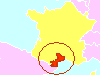
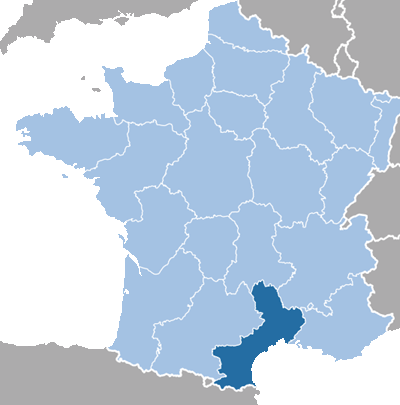
Languedoc-Roussillon
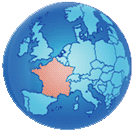
is one of the most fascinating areas of Europe, bordering
the Mediterranean
Sea to the east and the Pyrenees
Mountains to the south. It benefits from an exceptional
climate
(a
"Mediterranean Climate") and has an unusually
rich wildlife,
a spectacular coast,
and surprising history.
Things
to see include mountains,
rivers
and lakes, ancient
cities, towns,
villages,
thermal
springs, abbeys,
and cathedrals,
châteaux
and castles,
notably the famous mountain fortresses popularly known as
Cathar
Castles. It possesses a number of World
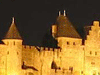
Heritage sites, including Carcassonne,
the Canal
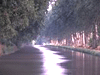
du Midi, and the Pont
du Gard.
The
Languedoc-Roussillon
is one of the most fascinating areas of Europe, bordering
the Mediterranean
Sea to the east and the Pyrenees
Mountains to the south. It benefits from an exceptional
climate
(a
"Mediterranean Climate") and has an unusually
rich wildlife,
a spectacular coast,
and surprising history.
Things
to see include mountains,
rivers
and lakes, ancient
cities, towns,
villages,
thermal
springs, abbeys,
and cathedrals,
châteaux
and castles,
notably the famous mountain fortresses popularly known as
Cathar
Castles. It possesses a number of World
Heritage sites, including Carcassonne,
the Canal
du Midi, and the Pont
du Gard.
|
|

Things to do in the Languedoc-Roussillon include a range of holidays, including naturist holidays and activity holidays. Sports include a wide range of land sports, water sports, air sports, mountain sports, winter sports, golf, hunting, shooting, hawking, and fishing. There are also numerous cultural activities, along with French regional food specialties, and Languedoc wines. Local festivals range from bull-running to the Fecos in Limoux and from sea-jousting in the north to celebrating la jour de St-Jean in the south by fire-jumping.
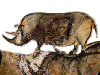
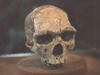
 The
Languedoc has a rich prehistory
and history,
including Celts,
Hannibal
with his elephants, Greeks,
Romans,
Visigoths,
Moors,
and Franks.
Find out about the Medieval
period, before the area was annexed by France, when its
language, the
Langue d'Oc, was the premier literary language of
Europe, and its rulers, the Counts
of Toulouse, were the most tolerant and enlightened
rulers in the Western World.
The
Languedoc has a rich prehistory
and history,
including Celts,
Hannibal
with his elephants, Greeks,
Romans,
Visigoths,
Moors,
and Franks.
Find out about the Medieval
period, before the area was annexed by France, when its
language, the
Langue d'Oc, was the premier literary language of
Europe, and its rulers, the Counts
of Toulouse, were the most tolerant and enlightened
rulers in the Western World.
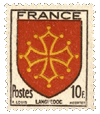
The name Languedoc is used in many different ways: it can
denote an area once known as Septimania,
or a larger area once ruled by the The
House of Toulouse which was annexed by France and cut
down to become the Province
of Languedoc under the ancien regime. It can also be
used the denote the area where Occitan
was the first language - over a third of modern France plus
small parts of modern Spain and modern Italy. This area
was once called Languedoc and is now more usually called
Occitania.
The term Languedoc can also be used to denote the four departements
in the modern French region of Languedoc-Roussillon
(Aude,
Gard,
Hérault,
Lozère,
but not the Pyrénées-Orientales).
For more on the changing names and borders of the Languedoc
click on this link to Provincia
Gallia Narbonensis, Septimania, the Kindom of Narbonne,
Gothia, County of Toulouse, Province of Languedoc, Occitania
and Languedoc-Roussillon 
Some Languedoc-Roussillon Superlatives