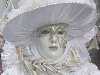
Things to do in the Languedoc: Cultural
Activities: The Limoux Carnival ( Fécos,
  Carnaval,
  Carnival)
   The
typical village fête is held in late summer when the
nights are still warm, and the crops and grapes have been
harvested. But the annual fête in Limoux, is different
in almost every respect. For a start it lasts not three days,
but over two months; and not in summer but mid winter. It
is the earliest and longest fête in the French calendar,
starting in January and continuing until two weeks before
Easter Sunday. The
typical village fête is held in late summer when the
nights are still warm, and the crops and grapes have been
harvested. But the annual fête in Limoux, is different
in almost every respect. For a start it lasts not three days,
but over two months; and not in summer but mid winter. It
is the earliest and longest fête in the French calendar,
starting in January and continuing until two weeks before
Easter Sunday.
It is claimed that this fête has been held continuously
since the middle ages. During revolutionary times an Arrêté
of the Municipal Council dated February 1793 attempted to
suppress it, but without success. No-one knows how it all
originated. Some say it originally celebrated concessions
made to the town by a nearby monastery during the Middle Ages.
Others say that it was started by millers in the sixteenth
century celebrating their successful trade with the kingdom
of Aragon. Others link it with the local sparkling white wine
called Blanquette
de Limoux, an ancient wine that gave winegrowers in Champagne
the idea for their product.
 The
earliest written record of the Limoux fête seems to
be a regulation of 1604, but the truth is that the it has
probably been evolving since well before medieval times, adopting
new features over the centuries. At some stage it has been
partially merged with the Christian Lent carnival, and with
pierrot traditions. The introduction of women in 1972
was just the latest in a long history of evolutionary change.
You will find modern musical instruments but also medieval
cornemuses, Micky Mouse costumes and traditional pierrots,
the latest fashions and Fransiscan habits. Hats range from
medieval headgear through eighteenth century tricorns to top
hats and baseball caps. The
earliest written record of the Limoux fête seems to
be a regulation of 1604, but the truth is that the it has
probably been evolving since well before medieval times, adopting
new features over the centuries. At some stage it has been
partially merged with the Christian Lent carnival, and with
pierrot traditions. The introduction of women in 1972
was just the latest in a long history of evolutionary change.
You will find modern musical instruments but also medieval
cornemuses, Micky Mouse costumes and traditional pierrots,
the latest fashions and Fransiscan habits. Hats range from
medieval headgear through eighteenth century tricorns to top
hats and baseball caps.
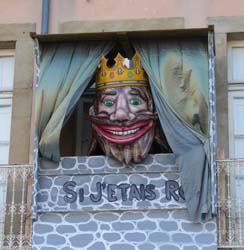  The
Limoux fête is generally called a Carnival (Carnaval
in French), but its real name is Fécos,
the local name for its characteristic dances. It starts with
a parade of the organising committee dressed up in comic masks,
white baggy shirts and trousers, wearing red scarves and clogs,
and carrying whips. These Meuniers (Millars) receive
His Majesty, the King of the Carnival, a stuffed dummy, who
will preside in a theoretical sort of way over the proceedings
over the coming weeks. The
Limoux fête is generally called a Carnival (Carnaval
in French), but its real name is Fécos,
the local name for its characteristic dances. It starts with
a parade of the organising committee dressed up in comic masks,
white baggy shirts and trousers, wearing red scarves and clogs,
and carrying whips. These Meuniers (Millars) receive
His Majesty, the King of the Carnival, a stuffed dummy, who
will preside in a theoretical sort of way over the proceedings
over the coming weeks.
|

|
|
Each weekend there will be more parades in the main
square, stopping at the cafés shown on the left
to entertain and annoy the customers.

Every Saturday and Sunday (and on Shrove Tuesday -
Mardi Gras) a bande will make a number
of outings in and around the square. Each bande
consists of a group of masked pierrots and their
accompanying musicians who follow the pierrots
from one café to another in the square, playing
as they walk along, through a tunnel of spectators lining
the ancient arcades.
|
|
|
  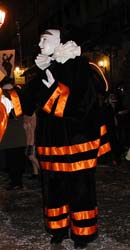 Pierrots
wear a sort of uniform, the forerunner of our modern clown
outfit. Each bande has its own distinctive colours,
often based on the traditional Limoux version: black with
brilliant shiny bands. Pierrots wear a curious expressionless
mask. They each carry a long, flexible, decorated wand called
a carabéna, and a large bag of confetti. Pierrots
wear a sort of uniform, the forerunner of our modern clown
outfit. Each bande has its own distinctive colours,
often based on the traditional Limoux version: black with
brilliant shiny bands. Pierrots wear a curious expressionless
mask. They each carry a long, flexible, decorated wand called
a carabéna, and a large bag of confetti.
 Pierrots
dance rhythmically in time to the music, delicately moving
their long springy wands over their heads. This rhythmic dance
is the Fécos. In the old days flour and sweets
were thrown around during the Fécos. Now confetti
is used instead - seven tons of it each year. If you take
photographs you will almost certainly receive a handful over
your head, delivered with grace and panache when you least
expect it. Pierrots
dance rhythmically in time to the music, delicately moving
their long springy wands over their heads. This rhythmic dance
is the Fécos. In the old days flour and sweets
were thrown around during the Fécos. Now confetti
is used instead - seven tons of it each year. If you take
photographs you will almost certainly receive a handful over
your head, delivered with grace and panache when you least
expect it.
 |
|
 |
|
|
|
  The
language of the Fécos, like the word Fécos
itself, is Occitan,
the traditional language of the area. Speeches are made and
songs are sung in it. Nothing is sacred during the Fécos.
Fun is poked at anything and anybody, from traditional local
targets to national politicians and other figures in the news.
Jokes and accusations that would offend in French seem to
be accepted with good grace in Occitan,
however risqué or slanderous. Some of the songs are
traditional, some written specially for this year's festival.
The musicians in each bande play a range of instruments:
trumpets, trombones, clarinets, tubas and drums. The occasional
cornemuse - a medieval bagpipe made from an entire animal
skin - also makes an appearance. The bandes play from a selection
of some eighty tunes, all in the local style, and not always
easy for outsiders to tell apart. Some of them owe a recognisable
debt to operas and operettas from the end of the 19th
Century and beginning of the 20th. The
language of the Fécos, like the word Fécos
itself, is Occitan,
the traditional language of the area. Speeches are made and
songs are sung in it. Nothing is sacred during the Fécos.
Fun is poked at anything and anybody, from traditional local
targets to national politicians and other figures in the news.
Jokes and accusations that would offend in French seem to
be accepted with good grace in Occitan,
however risqué or slanderous. Some of the songs are
traditional, some written specially for this year's festival.
The musicians in each bande play a range of instruments:
trumpets, trombones, clarinets, tubas and drums. The occasional
cornemuse - a medieval bagpipe made from an entire animal
skin - also makes an appearance. The bandes play from a selection
of some eighty tunes, all in the local style, and not always
easy for outsiders to tell apart. Some of them owe a recognisable
debt to operas and operettas from the end of the 19th
Century and beginning of the 20th.
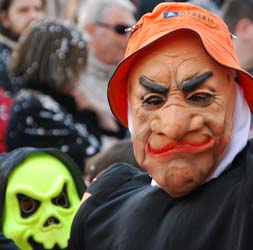
  Following
the pierrots and the musicians come the goudils.
They too are masked. But their masks and costumes are different
- different from the pierrots' and different from each
other. Each has a distinctive character - an old man, a cartoon
character, a harlequin, a fat woman, a local dignitary, a
clown, the President of the USA. It is often difficult to
determine the real sex of a goudil. There are few limits,
either to their inventiveness or taste. Following
the pierrots and the musicians come the goudils.
They too are masked. But their masks and costumes are different
- different from the pierrots' and different from each
other. Each has a distinctive character - an old man, a cartoon
character, a harlequin, a fat woman, a local dignitary, a
clown, the President of the USA. It is often difficult to
determine the real sex of a goudil. There are few limits,
either to their inventiveness or taste.
There are over 20 bandes - each of which performs
on just one day - once in the morning, once in the afternoon
and once in the evening. Anyone can join a bande as a goudil
- they are not members of the bande - but members
of one bande quite often join other bandes as
goudils.
 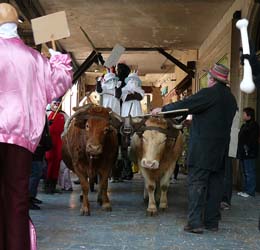 Pierrots
stop and speak to people. Their conversations or chines
also generally end in the distribution of confetti, scattered
over heads, rubbed gently into faces, pushed under hats or
inserted into shirts. Pierrots
stop and speak to people. Their conversations or chines
also generally end in the distribution of confetti, scattered
over heads, rubbed gently into faces, pushed under hats or
inserted into shirts.
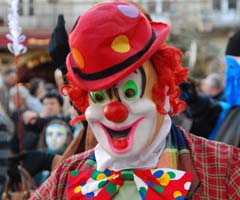
The fécos is not just a spectacle, and those
who witness it are not mere spectators. They are badauds,
participants in the fécos with their own special name
and their own special role. When they feel the sensuous caresses
of a carabéna
they become the centre of attention. The pierrot
on the other end of the carabéna
will be expecting to exchange witty repartee. "Te
counaissi" (I recognise you) says the goudil disguising
his voice, after which he may say something funny, or perhaps
not so funny. The badaud responds with as much wit
as possible. If he recognises the goudil as well he
will have won the exchange.
  
   The
groups who do this are all local. They resemble medieval guilds.
Children take part from an early age and the rules that are
applied so strictly to everyone else are largely ignored for
children in fact is often just an excuse to dress up and have
fun. The
groups who do this are all local. They resemble medieval guilds.
Children take part from an early age and the rules that are
applied so strictly to everyone else are largely ignored for
children in fact is often just an excuse to dress up and have
fun.
 The
first outing starts at 11 a.m., generally inspired by a topical
event, ribald or grotesque wherever possible. The 4:30 p.m.
outing is slower and the costumes more traditional. The 10
p.m. outing is the most atmospheric with an even slower rhythm.
It is lit by entorches. These are burning torches made
using ancient techniques. They burn for a full 2 hours. By
their light the pierrots process, slowly moving their
carabénas and distributing
confetti. It all makes a colourful spectacle. Other events
are held from time to time, for example the king might be
brought down to judge a spoof beauty contest. The
first outing starts at 11 a.m., generally inspired by a topical
event, ribald or grotesque wherever possible. The 4:30 p.m.
outing is slower and the costumes more traditional. The 10
p.m. outing is the most atmospheric with an even slower rhythm.
It is lit by entorches. These are burning torches made
using ancient techniques. They burn for a full 2 hours. By
their light the pierrots process, slowly moving their
carabénas and distributing
confetti. It all makes a colourful spectacle. Other events
are held from time to time, for example the king might be
brought down to judge a spoof beauty contest.
   At
first glance you might imagine it had all been invented for
the benefit of tourists, but this is not the tourist season.
And there are older, deeper elements at play. The pierrots
dress with almost religious care. Every action is dictated
by rules, some written, some passed down by word of mouth.
For example pierrots must never remove their masques
in public. They must wear "very fine" escarpins and gloves,
and a cagoule under their masques. They hold the carabinas
in a special way. They must move slowly, dancing by moving
only their arms and legs, not heads or bodies. They lead the
musicians and interact with them - the interplay can be surprisingly
intense. Only at their command will the music stop. There
are always 14 musicians and if you look carefully you will
notice that they are being conducted by the three rear-most
pierrots. Goudils must always remain behind
the musicians. There are secrets too. Those entorches
are made with resins according to a jealously preserved method,
dating from a time when people had their own recipes for such
things. At
first glance you might imagine it had all been invented for
the benefit of tourists, but this is not the tourist season.
And there are older, deeper elements at play. The pierrots
dress with almost religious care. Every action is dictated
by rules, some written, some passed down by word of mouth.
For example pierrots must never remove their masques
in public. They must wear "very fine" escarpins and gloves,
and a cagoule under their masques. They hold the carabinas
in a special way. They must move slowly, dancing by moving
only their arms and legs, not heads or bodies. They lead the
musicians and interact with them - the interplay can be surprisingly
intense. Only at their command will the music stop. There
are always 14 musicians and if you look carefully you will
notice that they are being conducted by the three rear-most
pierrots. Goudils must always remain behind
the musicians. There are secrets too. Those entorches
are made with resins according to a jealously preserved method,
dating from a time when people had their own recipes for such
things.
 |
|
|
 |
|
|
  Look
a little closer still, and you will find yet older, darker
elements. Chines for example are not always innocent
fun. Anonymity allows things to be said that would otherwise
remain unsaid. Those cagouls and masks, gloves and the disguised
voices are important ways to help conceal a pierrot's
identity. Many a badaud has been caressed by a carabéna,
looked into a mask, and heard a strange voice confide some
dreadful or embarrassing truth about questionable business
deals, illegal activities or private family matters. Look
a little closer still, and you will find yet older, darker
elements. Chines for example are not always innocent
fun. Anonymity allows things to be said that would otherwise
remain unsaid. Those cagouls and masks, gloves and the disguised
voices are important ways to help conceal a pierrot's
identity. Many a badaud has been caressed by a carabéna,
looked into a mask, and heard a strange voice confide some
dreadful or embarrassing truth about questionable business
deals, illegal activities or private family matters.
  On
the last night of the last day of Carnival, the Sunday before
Palm Sunday, a trial is held of the King of the Carnival.
At midnight His Majesty, the straw mannequin, is tied to a
stake and judge, prosecuter, defence council, and an executioner
make speaches - all in Occitan.
The King is defended vigorously but the prosecution wins the
case and the King is condemned to death. Through the fun and
games there is a reminder that this is the area where the
Cathars
flourished, where the medieval Inquisition
was created by Saint
Dominic's Dominican friars, and where countless people
were burned alive for the crime of chosing their own form
of religious belief. Even the joke executioner in his black
hood can send a chill down the spine. On
the last night of the last day of Carnival, the Sunday before
Palm Sunday, a trial is held of the King of the Carnival.
At midnight His Majesty, the straw mannequin, is tied to a
stake and judge, prosecuter, defence council, and an executioner
make speaches - all in Occitan.
The King is defended vigorously but the prosecution wins the
case and the King is condemned to death. Through the fun and
games there is a reminder that this is the area where the
Cathars
flourished, where the medieval Inquisition
was created by Saint
Dominic's Dominican friars, and where countless people
were burned alive for the crime of chosing their own form
of religious belief. Even the joke executioner in his black
hood can send a chill down the spine.
  Immediately
after the trial the King of the Carnival is burned on a pyre
in the centre of the main square, as the pierrots throw
their carabénas and masques into the flames:
They chant "Adiou paure canaval, tu t'en vas e iu demori
jusqu'à l'annada que ven" (Goodbye poor Carnival,
you go, and I remain until next year). Participants fall to
their knees bewailing His Majesty's passing and bowing to
the ground towards his burning remains, then stand up, join
hands, and dance around the fire singing bawdy ditties about
the coming Spring. They do this three times as the King burns,
then the Carnival is over for another year. Immediately
after the trial the King of the Carnival is burned on a pyre
in the centre of the main square, as the pierrots throw
their carabénas and masques into the flames:
They chant "Adiou paure canaval, tu t'en vas e iu demori
jusqu'à l'annada que ven" (Goodbye poor Carnival,
you go, and I remain until next year). Participants fall to
their knees bewailing His Majesty's passing and bowing to
the ground towards his burning remains, then stand up, join
hands, and dance around the fire singing bawdy ditties about
the coming Spring. They do this three times as the King burns,
then the Carnival is over for another year.


 The
annual Spring election and sacrifice of a king is well known
to anthropologists. It is a popular theme found in many cultures
around the world marking the passing of one year and the birth
of the new. In Europe it often points to origins not in the
Middle Ages but in prehistoric times. The
annual Spring election and sacrifice of a king is well known
to anthropologists. It is a popular theme found in many cultures
around the world marking the passing of one year and the birth
of the new. In Europe it often points to origins not in the
Middle Ages but in prehistoric times.
So the reason that the origins of the festival at Limoux
seems so hazy is not that early written records have been
lost. It is rather that the origins date back to a time before
writing had been invented, a time when real people rather
than straw effigies were sacrificed to help restore the sun,
usher in the Spring and ensure a good harvest.
- Click below for photographs of the 2010 Carnival:
- Les
Meuniers, Sunday 10 January, 2010 Carnival

- Les
Remenils & Les Infialurs d'Achille, Saturday 16
January, 2010 Carnival
- Le
Tivoli, Sunday 17 January, 2010 Carnival
- Las
Piotos & Les Drôles, Saturday 23 January,
2010 Carnival
- Monte
Cristo, Sunday 24 January, 2010 Carnival
- Las
Encatados & Las Poupinetos, Saturday 30 January
2010 Carnival
- Les
Aïssables, Sunday 31 January 2010 Carnival
- Les
Brounzinaïres & Les Rambaïurs, Saturday
6 February 2010 Carnival
- Les
Blanquetiers, Sunday 7 February 2010 Carnival
- Les
Pébradous & Les Sieur d'Arques, Saturday
13th February 2010 Carnival
- Le
Paradou, Sunday 14th February 2010 Carnival
- Les
Anciens, Tuesday 16 February 2010 Carnival (Mardi Gras)
- Les
Pitchouns et Las Taps, Saturday 20th February 2010 Carnival
- Las
Fennos, Sunday 21st February 2010 Carnival
- Les
Estabousits & Las Coudenos, Saturday 27th February
2010 Carnival
- L'Aragou,
Sunday 28th February 2010 Carnival
- Les
Afogats de Limoux, Saturday 6th March 2010 Carnival
- Carnavals
of the World, Saturday 6th March 2010 Carnival
- All
the Bandes, Sunday 7th March 2010 Carnival
- Les
Retraités, Friday 12th March 2010 Carnival
- Les
Maïnatches et Les Copins, Saturday 13th March 2010
Carnival. am
pm
- Les
Arcadiens, Sunday 14th March 2010 Carnival
- Sortie
des écoles, Tuesday 16th March 2010 Carnival
- Les
Limouxins and Les Jouves, Saturday 20th March 2010 Carnival,
am
& pm
evening
- Le
Pont-Vieux, Nuit de la Blanquette, Cremation, Sunday
21st March 2010 Carnival
- Click below for photographs of the 2009 Carnival:
- Click below for photographs of the 2008 Carnival:
- Les
Aïssables, 6th January 2008 Carnival
- Les
Pébradous, 26th January 2008 Carnival
- Las
Femnos, 27 January, 2008 Carnival
- Les
Pitchouns & Las Coudenos, 2nd February 2008 Carnival
- Les
Anciens, 5th February, 2008 Carnival
- Les
Estabousits & Les Taps, 9th February 2008 Carnival
- Le
Tivoli, 2nd March 2008 Carnival
- Monte
Cristo , 9th March 2008 Carnival
+ La
Nuit de la Blanquette
Click
here to go to the main Limoux page
Click
here for more on Blanquette de Limoux and Cremant de Limoux
Click
here for more photographs of Limoux
Click
here for more the Toque et Clocher at Limoux
Click
here for more photographs of the Languedoc and the Midi
Index of Bands
| |
|
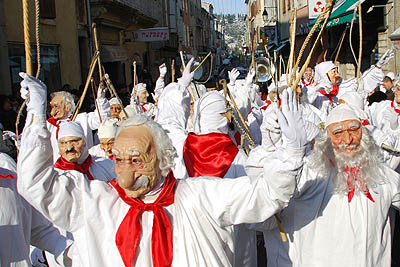
Meuniers |
| meaning |
|
"Millars" |
| founded |
|
|
| outfit |
|
Plain shirt & trousers. Wooden
Clogs. |
| colours |
|
white with red scarf |
| mask |
|
various |
| hat |
|
optional white bonnet |
| gloves |
|
white |
| carabine |
|
whip instead of carabine |
| confetti |
|
white in white bags |
| seat |
|
N/A |
| |
|
members of the committee |
|
Always opens the fecos on the sunsay 12 weeks
before Easter Sunday.
|
|
|
 |
| |
|
|
| |
|
Les Infialurs d'Achile |
| meaning |
|
"troublemakers of Achilles"
in Occitan |
| founded |
|
1993 |
| outfit |
|
Pierrot |
| colours |
|
blue and white |
| mask |
|
white painted blue & gold |
| hat |
|
blue & white |
| gloves |
|
white |
| carabine |
|
blue & white |
| ruff |
|
blue & white |
| confetti |
|
blue & white in white bags |
| seat |
|
Café de la Terrace |
|
|
|
Saturday Cycle
Used to parade anticlockwise around the square
|
| |
|
|
 |
| |
|
|
| |
|
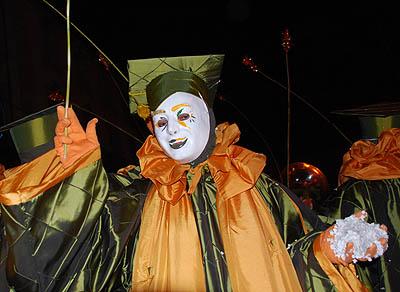
Les Remenils |
| meaning |
|
|
| founded |
|
1996 |
| outfit |
|
Pierrot |
| colours |
|
green & orange |
| mask |
|
white painted geen & gold |
| hat |
|
green academic square with orange
tassel |
| gloves |
|
orange |
| ruff |
|
orange |
| carabine |
|
white with orange feather |
| confetti |
|
white in orange bags |
| seat |
|
Café de la Terrace |
|
|
|
Saturday Cycle |
| |
|
|
 |
| |
|
|
| |
|
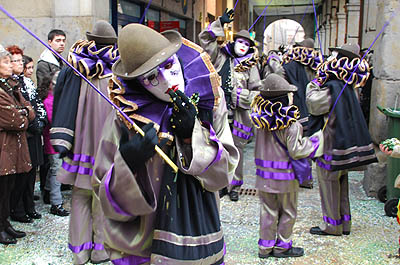
Le Tivoli |
| meaning |
|
Name of a promanade in Limoux |
| founded |
|
1958 |
| outfit |
|
Pierrot |
| colours |
|
grey & purple |
| mask |
|
white painted |
| hat |
|
grey, Gaston Phebus Hunters hat |
| gloves |
|
black |
| ruff |
|
purple edged with gold & jewels |
| carabine |
|
purple with gold handle & feather |
| confetti |
|
white in black & silver bags |
| seat |
|
Café de France |
|
|
|
Members of Committee, Sunday cycle |
| |
|
|
 |
| |
|
|
| |
|
Les Droles |
| meaning |
|
"The Funnies" |
| founded |
|
2006 |
| outfit |
|
Pierrot |
| colours |
|
orange & blue |
| mask |
|
white painted |
| hat |
|
orange bonnets |
| gloves |
|
white |
| ruff |
|
blue & orange |
| carabine |
|
blue & orage with blue feather |
| confetti |
|
white in blue bags |
| seat |
|
|
|
|
|
Saturday Cycle
http://bandedecarnavallesdroles.midiblogs.com/ |
| |
|
|
 |
| |
|
|
| |
|
Les Piotos |
| meaning |
|
???? |
| founded |
|
1993 |
| outfit |
|
gown |
| colours |
|
black & white |
| mask |
|
white with silver painting |
| hat |
|
black with white rosette (and red
wig) |
| gloves |
|
black |
| ruff |
|
white with black lacing |
| carabine |
|
black & white with white feather |
| confetti |
|
white in black bags |
| seat |
|
Café Jo |
|
|
|
Saturday cycle
Twinned with the Estabousits |
| |
|
|
 |
| |
|
|
| |
|
Monte Cristo |
| meaning |
|
|
| founded |
|
1968 |
| outfit |
|
pierrot |
| colours |
|
broun & bronze |
| mask |
|
white with brown painting |
| hat |
|
brown tricorn or brown broad brimmed
hat |
| gloves |
|
bronze |
| ruff |
|
bronze |
| carabine |
|
bronze with bronze & white feather |
| confetti |
|
white in bronze bags |
| seat |
|
Café des Arcades |
|
|
|
Members of Committee, Sunday cycle
There is an alternative much fancier version of
the outfit worn by women |
| |
|
|
 |
| |
|
|
| |
|
Encantados |
| meaning |
|
"Enchanted" |
| founded |
|
1995 |
| outfit |
|
pierrot, two buttons |
| colours |
|
white & blue or maroon |
| mask |
|
white, painted |
| hat |
|
blue or maroon sock hats |
| gloves |
|
white |
| ruff |
|
gold lamé & blue or maroon |
| carabine |
|
silver |
| confetti |
|
white in a blue or maroon bag |
| seat |
|
Bistrot du Goût (x Café
de France) |
|
|
|
Saturday Cycle |
| |
|
|
 |
| |
|
|
| |
|
Poupinetos |
| meaning |
|
"Little dolls" |
| founded |
|
2008 |
| outfit |
|
dress & drawers |
| colours |
|
red & white |
| mask |
|
white painted |
| hat |
|
red broad brimmed hat |
| gloves |
|
white |
| ruff |
|
white |
| carabine |
|
red and white with red handle and
feather |
| confetti |
|
white in red bag |
| seat |
|
|
|
|
|
Saturday cycle |
| |
|
|
 |
| |
|
|
| |
|
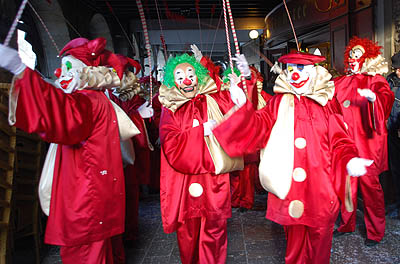
Les Aïsables |
| meaning |
|
"unbearables" in Occitan |
| founded |
|
1981 |
| outfit |
|
pierrot |
| colours |
|
red & cream |
| mask |
|
white clown mask with red or green
hair |
| hat |
|
red bonnet or joker's cap |
| gloves |
|
cream |
| ruff |
|
cream |
| carabine |
|
red and white with red handle and
feather |
| confetti |
|
white |
| seat |
|
Café de Commerce |
|
|
|
Members of Committee, Sunday cycle |
| |
|
|
 |
| |
|
|
| |
|
Les Brounzinaïres |
| meaning |
|
|
| founded |
|
|
| outfit |
|
pierrot, two buttons + one on each
leg |
| colours |
|
white & brown |
| mask |
|
white , painted |
| hat |
|
brown acorn hats |
| gloves |
|
white |
| ruff |
|
brown and gold |
| carabine |
|
brown and gold with a white feather |
| confetti |
|
white |
| seat |
|
Café "Al Limos" |
|
|
|
Saturday cycle |
| |
|
|
 |
| |
|
|
| |
|
Les Rambaïurs |
| meaning |
|
|
| founded |
|
|
| outfit |
|
pierrot |
| colours |
|
red & white |
| mask |
|
white, painted |
| hat |
|
red |
| gloves |
|
white |
| ruff |
|
silver |
| carabine |
|
red and white with red handle and
feather |
| confetti |
|
white |
| seat |
|
|
|
|
|
Saturday cycle |
| |
|
|
 |
| |
|
|
| |
|
Les Blanquetiers |
| meaning |
|
|
| founded |
|
1973 |
| outfit |
|
pierrot |
| colours |
|
purple & yellow |
| mask |
|
white, painted |
| hat |
|
conical, purple with 3 buttons |
| gloves |
|
black |
| ruff |
|
yellow |
| carabine |
|
purple & yellow, with yellow feather |
| confetti |
|
yellow |
| seat |
|
Café du Commerce |
|
|
|
Member of Committee, Sunday cycle |
| |
|
|
 |
| |
|
|
| |
|
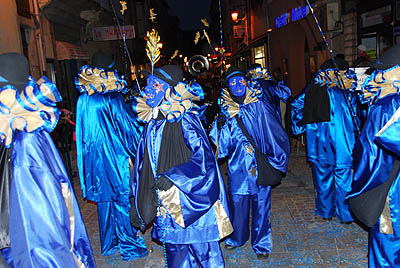
Pebradous |
| meaning |
|
|
| founded |
|
|
| outfit |
|
pierrot |
| colours |
|
blue & white |
| mask |
|
blue, painted in gold |
| hat |
|
black Gaston Phebus Hunters hat, blue
band |
| gloves |
|
black |
| ruff |
|
white trimmed in blue |
| carabine |
|
blue & gold, with a blue feather |
| confetti |
|
blue & yellow |
| seat |
|
|
|
|
|
Saturday cycle |
| |
|
|
 |
| |
|
|
| |
|
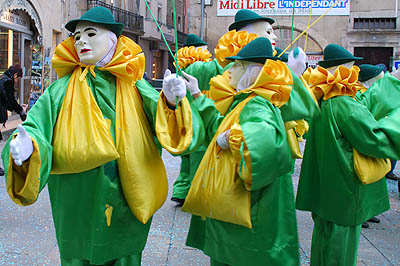
Sieurs d'Arques |
| meaning |
|
name of a local wine cooperative |
| founded |
|
1975 |
| outfit |
|
pierrot |
| colours |
|
green & yellow |
| mask |
|
white, painted |
| hat |
|
green Gaston Phebus Hunters hat |
| gloves |
|
white |
| ruff |
|
yellow |
| carabine |
|
green, with yellow feather |
| confetti |
|
white |
| seat |
|
Maison de la Blanquette |
|
|
|
Saturday cycle
The green represents vines and the yellow, grapes |
| |
|
|
 |
| |
|
|
| |
|
Le Paradou |
| meaning |
|
|
| founded |
|
1947 |
| outfit |
|
pierrot, parti coloured with 3 countercharged
buttons |
| colours |
|
black & white |
| mask |
|
white, painted wth pink cheeks |
| hat |
|
black with white button |
| gloves |
|
white |
| ruff |
|
black & white |
| carabine |
|
black & white, with a white feather |
| confetti |
|
white in a black bag |
| seat |
|
Café Jo |
|
|
|
Member of Committee, Sunday cycle |
| |
|
|
 |
| |
|
|
| |
|
Les Anciens |
| meaning |
|
|
| founded |
|
1927 |
| outfit |
|
pierrot |
| colours |
|
white & red/blue/green/purple/black |
| mask |
|
white, painted |
| hat |
|
white with red/blue/green/purple/black
band |
| gloves |
|
white |
| ruff |
|
red/blue/green/purple/black |
| carabine |
|
silver with red/blue/green/purple/black
feather |
| confetti |
|
white in a red/blue/green/purple/black
bag |
| seat |
|
Café des Arcades |
|
|
|
Always come out on Mardi Gras (Shrove
Tuesday) |
| |
|
|
 |
| |
|
|
| |
|
Les Pitchouns |
| meaning |
|
|
| founded |
|
|
| outfit |
|
pierrot or tunic & skirt with
belt & two buttons (women) |
| colours |
|
blue & gold or white & black
(women) |
| mask |
|
white, painted blue & gold or
black & gold (women) |
| hat |
|
white, rounded conical (acorn hats) |
| gloves |
|
white or black (women) |
| ruff |
|
gold fringed blue or black (women) |
| carabine |
|
white with blue feather or black &
white feather (women) |
| confetti |
|
white in a gold bag or a black bag
(women) |
| seat |
|
Tivoli |
|
|
|
Saturday cycle |
| |
|
|
 |
| |
|
|
| |
|
Las Taps |
| meaning |
|
|
| founded |
|
|
| outfit |
|
pierrot |
| colours |
|
red & white |
| mask |
|
white, painted |
| hat |
|
red & gold jesters' cap |
| gloves |
|
white |
| ruff |
|
red & gold |
| carabine |
|
gold with red feather |
| confetti |
|
white in a red bag |
| seat |
|
|
|
|
|
Saturday cycle |
| |
|
|
 |
| |
|
|
| |
|
Las Fennos |
| meaning |
|
Occitan for "women" |
| founded |
|
1972 |
| outfit |
|
CHANGES EVERY YEAR |
| colours |
|
|
| mask |
|
|
| hat |
|
|
| gloves |
|
|
| ruff |
|
|
| carabine |
|
|
| confetti |
|
|
| seat |
|
Café du Commerce |
|
|
|
Members of the Committee, Sunday cycle |
| |
|
|
 |
| |
|
|
| |
|
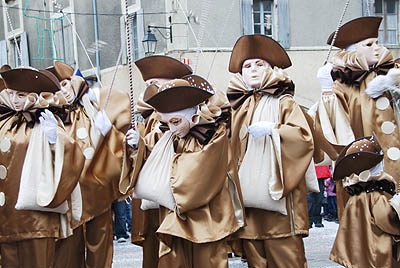
Les Estabousits |
| meaning |
|
|
| founded |
|
1982 |
| outfit |
|
pierrot |
| colours |
|
bronze & brown |
| mask |
|
flesh coloured, painted |
| hat |
|
brown tricorn |
| gloves |
|
white |
| ruff |
|
cream & brown |
| carabine |
|
bronze & brown, with brown handle
& feather |
| confetti |
|
white in a cream sack |
| seat |
|
Café des Arcades |
|
|
|
Saturday cycle
Twinned with the Piotos |
| |
|
|
 |
| |
|
|
| |
|
Las Cudenos |
| meaning |
|
|
| founded |
|
|
| outfit |
|
pierrot |
| colours |
|
violet & black |
| mask |
|
white, painted black, violet &
silver |
| hat |
|
black top hat with violet ribbon |
| gloves |
|
white |
| ruff |
|
black & violet |
| carabine |
|
black & violet with violet-black-violet
feathers |
| confetti |
|
white in a black & violet bag |
| seat |
|
Le Tivoli |
|
|
|
Saturday cycle
http://carnaval.lascoudenos.free.fr/
|
| |
|
|
 |
| |
|
|
| |
|
L'Aragou |
| meaning |
|
|
| founded |
|
1976 |
| outfit |
|
pierrot with 3 red buttons, red shoes |
| colours |
|
brown & red |
| mask |
|
latex, white, unpainted |
| hat |
|
red acorn hat |
| gloves |
|
white |
| ruff |
|
red |
| carabine |
|
brown & red, with red feathers |
| confetti |
|
brown in a brown sack |
| seat |
|
Café Jo |
|
|
|
Member of the Committee, Sunday cycle |
| |
|
|
 |
| |
|
|
| |
|
Les Afogats de Limoux |
| meaning |
|
|
| founded |
|
2009 ? |
| outfit |
|
pierrot with three buttons on the
front |
| colours |
|
white & red |
| mask |
|
white with painted red rose on the
right and optional red stars and tears on the left |
| hat |
|
white acorn hat with one red button |
| gloves |
|
white |
| ruff |
|
red trimmed white |
| carabine |
|
white with red and white feathers |
| confetti |
|
white |
| seat |
|
|
|
|
|
Saturday cycle |
| |
|
|
 |
| |
|
|
| |
|
Les Retraités |
| meaning |
|
Retired |
| founded |
|
|
| outfit |
|
none - goudil or pierrot |
| colours |
|
|
| mask |
|
|
| hat |
|
|
| gloves |
|
|
| ruff |
|
|
| carabine |
|
|
| confetti |
|
|
| seat |
|
|
|
|
|
always on a Friday |
| |
|
|
 |
| |
|
|
| |
|
Les Maïnatches |
| meaning |
|
"Youngsters" in Occitan |
| founded |
|
1988 |
| outfit |
|
pierrot and clowns |
| colours |
|
various |
| mask |
|
pierrot and clowns |
| hat |
|
conical for pierrots, brimmed for
clowns |
| gloves |
|
various |
| ruff |
|
conical for pierrots, top hats for
clowns |
| carabine |
|
various |
| confetti |
|
white ? |
| seat |
|
Café du Progress |
|
|
|
Saturday cycle |
| |
|
|
 |
| |
|
|
| |
|
Les Copins |
| meaning |
|
"friends" |
| founded |
|
2004 |
| outfit |
|
pierrot |
| colours |
|
silver & indigo |
| mask |
|
white, painted indigo |
| hat |
|
grey acorn cap |
| gloves |
|
indigo |
| ruff |
|
indigo |
| carabine |
|
white & indigo with an indigio
feather |
| confetti |
|
white |
| seat |
|
|
|
|
|
Saturday cycle
http://cnature.free.fr/accueil |
| |
|
|
 |
| |
|
|
| |
|
Les Arcadiens |
| meaning |
|
refers to the arcades of the square |
| founded |
|
1956 |
| outfit |
|
white pierrot |
| colours |
|
various |
| mask |
|
laughing in the afternnoon, crying
at night |
| hat |
|
conical three buttons of the pierrot's
colour |
| gloves |
|
white |
| ruff |
|
of the pierrot's colour |
| carabine |
|
white with multicoloured and serrated
feather at both ends |
| confetti |
|
white |
| seat |
|
Café du Commerce |
|
|
|
Member of the Committee, Sunday Cycle |
| |
|
|
 |
| |
|
|
| |
|
Les Limouxins |
| meaning |
|
"Residents of Limoux" |
| founded |
|
1966 |
| outfit |
|
robe |
| colours |
|
mustard & maroon |
| mask |
|
gold, plague doctor mask |
| hat |
|
maroon lined mustard, or maroon conical
cap |
| gloves |
|
black |
| ruff |
|
mustard & maroon |
| carabine |
|
mustard & maroon with a black
feather |
| confetti |
|
violet in a black bag |
| seat |
|
Café du Commerce |
|
|
|
Always on the Saturday before the cemation
Always wheel a bed around with them
http://limouxins.site.voila.fr/
|
| |
|
|
 |
| |
|
|
| |
|
Les Jouves |
| meaning |
|
"The Youths" in Occitan |
| founded |
|
1966 |
| outfit |
|
pierrot, white satin |
| colours |
|
white |
| mask |
|
various |
| hat |
|
various |
| gloves |
|
white |
| ruff |
|
white |
| carabine |
|
white with a white feather |
| confetti |
|
white in a white bag |
| seat |
|
al Limos |
|
|
|
Always on the Saturday before the
cemation |
| |
|
|
 |
| |
|
|
| |
|
Le Pont-Vieux |
| meaning |
|
name of a bridge in Limoux across
the river Aude |
| founded |
|
1952 |
| outfit |
|
pierrot |
| colours |
|
black with red bands |
| mask |
|
red loup |
| hat |
|
black with red cockade |
| gloves |
|
white |
| ruff |
|
white |
| carabine |
|
black & red, with a red feather |
| confetti |
|
white |
| seat |
|
Café des Arcades |
|
|
|
Member of the Committee, Sunday cycle |
| |
|
|
 |
| |
|
|
| |
|
|
The Words of Adieu paure Carnaval - sung during the cremation
| Adieu paure Carnaval (Occitan) |
Adieu pauvre Carnaval (Français) |
Goodbye Poor Carnaval (English) |
|
Adieu paure, adieu paure,
Adieu paure Carnaval
Tu t'en vas e ieu demòri
Adieu paure Carnaval
Tu t'en vas e ieu demòri
Per manjar la sopa a l'alh
Per manjar la sopa a l'òli
Per manjar la sopa a l'alh
Adieu paure, adiu paure,
Adieu paure Carnaval
La joinessa fa la fèsta
Per saludar Carnaval
La Maria fa de còcas
Amb la farina de l'ostal
Lo buòu dança, l'ase canta
Lo moton ditz sa leiçon
La galina canta lo Credo
E lo gat ditz lo Pater
|
Adieu, pauvre, adieu pauvre,
Adieu pauvre Carnaval
Tu t'en vas et moi je reste
Adieu pauvre Carnaval
Tu t'en vas et moi je reste
Pour manger la soupe à l'ail
Pour manger la soupe à l'huile
Pour manger la soupe à l'ail
Adieu pauvre, adieu pauvre,
Adieu pauvre Carnaval
La jeunesse fait la fête
Pour saluer Carnaval
Marie fait des brioches
Avec la farine de la maison
Le bœuf danse, l'âne chante
Le mouton dit sa leçon
La poule chante le Credo
Et le chat dit le Pater
|
Adieu poor, adieu poor
Adieu poor Carnival
You are going and I remain
Adieu poor Carnival
You are going and I remain
To eat garlic soup
To eat fatty soup
To eat garlic soup
Adieu poor, adieu poor
Adieu poor Carnival
Youth makes the festival
To salute Carnival
Marie make the brioche
With the flour of the house
The cow dances, the ass sings
The sheep recites its lesson
The chicken chants the Creed
And the cat says the Pater Noster
|
The Words of Adieu paure Carnaval (alternative version)
| |
|
|
Refrain
Adiu paure, Adiu paure
Adiu paure Carnaval
Tu t’en vas e ieu demori
Adiu paure Carnaval.
I
Le biou canta, l’ase dansa
Le moton ditz la lèiçon
E la lèbre canta l’credo
E l’aucèl ditz le pater.
II
Catarino la pissosa
Porta la civada als bious
E de blat a las galinas
Si vos que te fasquen d’ious.
III
La junèssa fa la fèsta
Totis les qu’i èm ongan
E les filhas fan las cocas
Per celebrar Carnaval.
IV
Pod pas beure, pod pas beure
Pod pas beure qu’es bandat
A manjat trop de salsissa
E de cambajon salat.
Refrain
Adiu paure, Adiu paure
Adiu paure Carnaval
Tu t’en vas e ieu demori
Per manjar la sopa à l’alh. |
Refrain
Adieu pauvre, Adieu pauvre
Adieu pauvre Carnaval
Tu t’en vas et moi je reste
Adieu pauvre Carnaval.
I
Le bœuf chante, l’âne danse
Le mouton dit la leçon
Et le lièvre chante le credo
Et l’oiseau dit le pater.
II
Catherine la pisseuse
Porte de l’avoine aux bœufs
Et du blé aux poules
Si tu veux qu’elles te fassent des œufs.
III
La jeunesse fait la fête
Tous ceux qui sont là cette année
Et les filles font des gâteaux
Pour célébrer Carnaval.
IV
Il ne peut pas boire, il ne peut pas boire
Il ne peut pas boire tant il est saoul
Il a mangé trop de saucisse
Et de jambon salé.
Refrain
Adieu pauvre, Adieu pauvre
Adieu pauvre Carnaval
Tu t’en vas et moi je reste
Pour manger la soupe à l’ail. |
Refrain
Adieu poor, adieu poor
Adieu poor Carnival
You are going and I remain
Adieu poor Carnival
I
The cow sings, the ass danses
the sheep recites the lesson
And the hare chants the Creed
And the bird recites the Pater Noster
II
Catherine the pisser
Carries the flour to the cows
And the corn to the chickens
If you want, she will make eggs
III
The young make the festival
All those who are there this year
And the girls make the cake
To celebrate Carnival
IV
He cannot drink, he cannot drink
He cannot drink, so drunk is he
He has eaten too much sausage
And to much salted ham
Refrain
Adieu poor, adieu poor
Adieu poor Carnival
You are going and I remain
To eat garlic soup |
The Ten Rules of the Carnaval
"Bien maqué tu seras, portant de beaux escarpins
et gants fins"
"Sous ton masque se trouvera, cagoule immanquablement".
" A ton épaule ne prendra point de besace, naturellement".
"A 11 heurs, 17 heures, 22 heures tu choisiras, air
de folklore pour ce moment là."
"Au départ tu retiendras la musique bien sagement,
car les premiers pas tu feras, sur le seuil du café
majestueusement".
"D'un café à l'autre tu danseras, sans
bousculade et énervement".
"Ni vite, ni lentement, vingt minutes suffiront largement".
"La musique tu méneras, avec amour dévotement.
Pour celà faire, ne chineras, mais intrigueras tout
simplement."
"A l'arrivée seul tu imposeras, à la musique
ton mouvement. Et l'arrêt ne se fera que sur ton commandement".
"Ainsi, fier tu seras d'avoir vécu tous ces moments.
Mais ton visage ne découvriras, que dans l'intimité
seulement."
|




 Back to last page.